




Do you have a license but don’t feel completely confident? Or maybe you drove a boat a few years ago and feel like you’ve forgotten the basics.
That’s very common, especially if you don’t spend much time on the water.
If you’re planning to rent a boat in Pula, this skipper training in Pula guide will help you refresh the essentials and feel more comfortable before heading out.
Before Departure
Before stepping on board, take a moment to check if you’ve brought everything you planned and if the boat has everything you need.
This includes supplies, safety equipment, basic first aid, and enough fresh water.
That’s the most important part — everything else is less important 🙂
Don’t forget to bring your skipper license with you — you may be asked to show it during your trip.
Always check the weather before departure.
Conditions in a protected marina can feel calm, while the open sea may be very different.
If the weather doesn’t look good, it’s completely fine to postpone your trip.
It’s always better to wait for the right conditions.
Even experienced skippers make this decision — especially when they are responsible for other people, children, or the boat itself. This is the first step of proper skipper training in Pula.
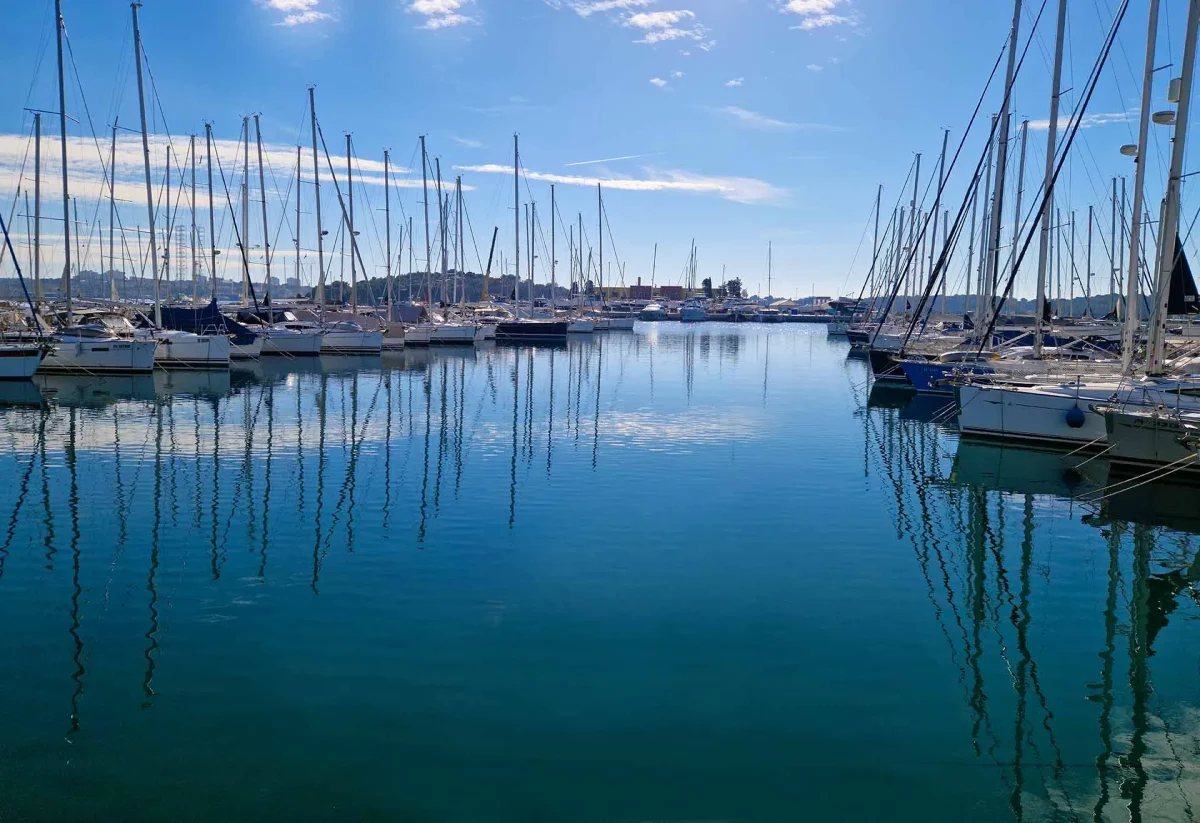
Engine Start Basics
A key part of skipper training in Pula is understanding how to safely start and control the boat.
Before anything else, check that the main power switch is turned on.
On boats we rent in Pula, it is located in front of the rear bench, in the area where your calves touch the seat. It must be turned clockwise to supply power to the cockpit and all onboard systems.
After turning it on, you can quickly check if the power is active by pressing the horn button.
Prepare the ignition key and turn it to the ready position.
If the engine is not already lowered, use the trim control to bring it down. The trim button is usually located on the throttle lever.
The ignition key is usually connected to a kill switch lanyard (engine cut-off switch).
Without the safety clip properly attached, the engine cannot be started.
It’s recommended to keep the lanyard attached to the driver at all times for safety.
The throttle lever must be in neutral, as the engine will not start if it is in gear.
Before starting the engine, take a quick moment to check your surroundings and make sure the area around the boat is clear.
Start the engine calmly, without adding throttle, and let it run for a few seconds before moving.
Understanding How a Boat Turns
The key difference between steering a car and a boat is that a car leads with the front, while a boat swings its stern in the opposite direction when turning.
In practice, this means the rear of the boat moves first — something to always keep in mind, especially in tight spaces.
That’s why it’s important to always pay attention to the stern, as it will move the most when you turn the wheel in any direction.
How Boat Turning Works in Practice
The easiest way to understand this is to see it in real conditions.
Notice how the stern moves in the opposite direction when turning.
This is one of the most important things to understand before leaving the marina.
Leaving the Berth (Four-Point Mooring)
Before starting the engine, take a moment to understand how the boat is secured.
In most marinas, the boat is tied in a four-point mooring system — with two mooring lines at the bow and two stern lines attached to the dock.
Releasing Mooring Lines (Calm Conditions)
If the weather is calm and there is little or no wind, there are several ways to release the mooring lines.
You can choose the method that feels most comfortable for you, depending on whether you are alone or have someone on board to assist.
When I’m alone, I sometimes secure my boat to the neighboring boat first. This allows me to safely release all mooring lines without the boat drifting away.
Once everything is released, I simply untie the line from the neighboring boat and move off in a controlled way.
Releasing Mooring Lines (Windy Conditions)
If it’s windy, always consider the wind direction when releasing the mooring lines.
Keep the mooring line on the windward side secured until the very end.
This will help you maintain control of the boat and prevent it from drifting too early.
Awareness While Releasing the Boat
Don’t be overly worried that the boat will immediately drift and hit others once the lines are released.
Boats are equipped with fenders, so light contact between boats is usually not a problem.
The area that requires the most attention is the stern, especially the engine.
It is the most exposed and sensitive part of the boat, so make sure to keep it clear of other boats and the dock at all times.
On our boats, you’ll find a telescopic boat hook as part of the basic equipment.
Locally in Pula, it’s often called mezomariner(o).
It works as an extended arm, helping you safely push away from the dock or other boats, and reach lines without unnecessary risk.

Final Step Before Departure
Be fully prepared before releasing the last mooring line.
The skipper should be in position at the helm, ready to move forward immediately.
As you begin to move, pay special attention to the stern, as it is the most exposed and sensitive part of the boat.
This is where skipper training in Pula becomes practical and real.
Ready to Leave the Marina
At this point, you are ready to leave the berth and head out to the open sea.
Take it slow, stay aware of your surroundings and remember — control and calm movements are always more important than speed.
Find more practical tips and boating advice in our Boat Guide for Pula and the Adriatic